
by Talking to Albertans
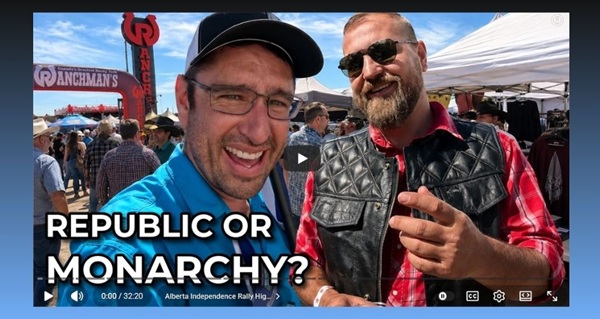
«Derek Fildebrandt believes an independent Alberta should seriously consider keeping the King during the transition—but would that give us real independence or simply create a smaller version of Canada?
At the Let Alberta Decide Alberta independence rally at Ranchman’s in Calgary, I unexpectedly ran into former Alberta MLA Derek Fildebrandt of the Western Standard. What began as a spontaneous encounter quickly became a serious conversation about Alberta independence, constitutional reform and what kind of country Alberta could become.
Derek is well known in Alberta politics for taking bold—and sometimes controversial—positions. I ask him: if Alberta becomes sovereign, what political system should replace the one we have now?
Should Alberta become a republic, elect a constitutional convention and write a new constitution—or initially remain a constitutional monarchy and preserve the Alberta Crown?
Derek argues that retaining the monarchy could provide the easiest and least disruptive transition away from Canada. Rather than immediately replacing every institution, Alberta could transfer the responsibilities of the federal Crown to the existing Alberta Crown while building the institutions required by a sovereign country.
He makes it clear that he is not defending King Charles personally. His argument is about continuity, stability and reducing uncertainty during a major transition.
I understand that argument, but my concern is what happens afterward.
Would Albertans become comfortable with an interim system and never complete the deeper reforms independence gives us an opportunity to pursue? Would we remove Ottawa but preserve the same concentration of political power, weak accountability and inadequate protection for individual freedom?
I do not want Alberta to become a miniature version of Canada.
I want meaningful checks and balances, stronger protections for speech and individual liberty, and a constitution that clearly limits government power.
He argues Alberta could retain the Crown while still creating elected institutions, stronger checks on political power and a constitutional structure designed specifically for Alberta.
We also discuss Derek’s larger vision for Western Canada.
Derek believes Alberta may need to “jump first.” In his view, Alberta independence could force Quebec to reconsider its place in Canada and begin a wider transformation. That could eventually create an opportunity for Alberta, Saskatchewan, northern British Columbia and the territories to form a new Western federation.
Whether or not that vision becomes possible, independence is not only about leaving Canada. It is about deciding what replaces the current system and whether we are willing to build something better.
This is the kind of respectful but serious debate the movement needs as Albertans consider not only whether to leave Canada, but what we would build next.
Earlier in the video, I also speak with John Tomkinson of United Alberta Flags.
United Alberta Flags is a registered referendum third-party advertiser distributing Alberta flags across the province. John tells me approximately 3,000 flags had been distributed during the previous ten days and that the response had been overwhelming.
Visible public support matters. Many Albertans support independence privately but remain hesitant to say so publicly. Every Alberta flag displayed on a home, vehicle, farm, business or prominent piece of land shows people they are not alone and demonstrates that the movement is active, visible and growing.
United Alberta Flags needs donations and volunteers to distribute flags across the province and place large Alberta flags along major highway corridors. I strongly support what John and his team are doing and encourage anyone who believes in Alberta self-determination to help.»